Boating Regulation & Safety
· No-wake zone (< 6 mph) within 150 feet (equivalent to half a football field) of the shoreline.
· Motorized boats may not operate to within 75 feet of floats or markers that designate swimming areas.
· Limit boat to headway/no-wake speed (<6 mph) when within 150 feet of a swimmer, the shoreline, a water-skier, a boat launch, a raft or float or a moored or docked boat.
· Maximum speed limit 45 mph for all watercraft including jet skis.
· No wake-jumping is advised as rapid unexpected turns increase risks of accidents.
· Furnish your boat per all MA state safety requirements.
· All kayakers/canoeists must wear a PFD (life preserver) from September 15 to May 15.
· Be courteous to fishermen, non-motorized boaters, & swimmers.
· If towing a skier/tuber, the designated spotter -- not the driver -- must keep eyes on skier/tuber at all times.
· All watercraft launched at the public boat launch must be inspected first. Beware of Zebra Mussels.
· For more information on Boating Safety visit Mass.gov website.
All Regulations Strictly Enforced by the Massachusetts Environmental Police.
To report violations: Call (800) 632-8075.

ZEBRA MUSSEL BOAT WASH STATION
· A NEW boat wash station was installed at the public boat launch of Richmond Pond as of June of 2026. It is a steam wash station powered electrically. It is housed in a shed alongside the boat launch.
· Pete Beckwith, the Richmond Dept. of Public Works Superintendent, has been training the boat monitors on the proper operation of the wash station.
· All boats should be scrubbed and washed down thoroughly at home with 140 degree temperature water or preferably at the wash station, especially if they have been used at other lakes besides Richmond Pond.
· The hours of operation of the boat wash station are the same as those for the public boat launch.
· Only the trained boat monitors are allowed to operate the boat wash station.
· As of this posting, there have been no Zebra Mussels identified at Richmond Pond. Let's keep it that way!
· Do your part to keep Richmond Pond free of Zebra Mussels. WASH YOUR BOAT!
To report any wash station problems contact Peter Beckwith.
Call: (413) 553-7794 or Email: highway@richmondma.org

Swimming Safety
· Be Red Cross Ready – learn to swim
· Know your abilities & the abilities of those swimming with you
· Keep children under constant supervision
· Always swim with a buddy
· Use lifeguard-staffed Richmond Town Beach when possible
· If swimming away from shore, trail a highly visible float or be accompanied by a spotter in a boat (otherwise, motorized boats cannot see you)
See also www.redcross.org/prepare/disaster/water-safety/swim-safety

DRONE USE AROUND RICHMOND POND
If you are planning to fly a drone, commercial or personal, within 2 miles of the Pittsfield Airport, which includes much of Richmond Pond and its surrounding dwellings, the following criteria must be met -- as per Anita Acor, Director of the Pittsfield Airport:
- Call the Airport Director at 413-448-9790, send an email to aakor@pittsfieldmass.gov or stop by the airport to alert them of your intentions at least 24 hours in advance.
- Please provide in your communication your name, contact information, date and time of proposed operation, location, maximum altitude of operation, and duration of operation.
- Height of drone flight may NOT exceed 400 feet.
- Aircraft always have right-of-way.
The intent of this communication of drone activity by the operator is to alert airplane pilots of this activity in order to maximize safety and prevent any accidents!

CYANOBACTERIA REPORTING AND SAMPLE COLLECTION
Richmond Pond Cyanobacteria Status: ALL CLEAR
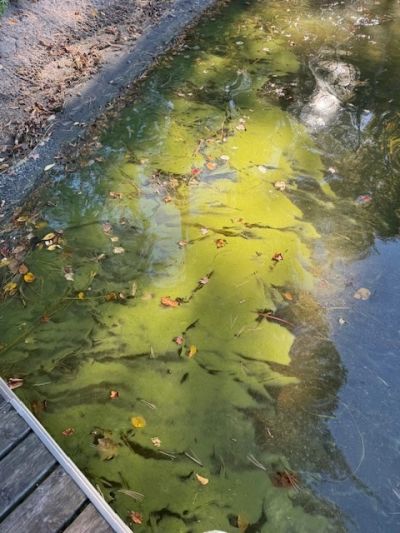
Cyanobacteria is a blue-green algae which can bloom in fresh water lakes under certain conditions. When a bloom is confirmed, the Town of Richmond and the City of Pittsfield will issue official safety alerts. This alert will also be posted on the homepage of the RPA website and in the subheading of this section above. These alerts will usually advise lake users to avoid swimming, boating, fishing, and pet exposure. After a confirmed bloom has been posted, clearance of the visible bacterial mat and obligatory testing are necessary for the "all clear" sign to be given. The lifting of lake restrictions will be posted in the same manner as the initial alert. Cyanotoxins can still cause illness and symptoms for a time even after the visible bacterial mat is no longer present, so waiting until the restrictions are formally lifted is very important.
For more detailed information regarding Cyanobacteria please refer to the following resources:
Cyanobacteria DPH Presentation
Mass DEP Cyanobacteria Presentation
Keeping Our Lake Safe
If you suspect a Cyanobacteria bloom, here are the following steps you can take:
- Call or email Shannon Poulin from LAPA West at 413-499-9359 or spoulin@pittsfieldma.gov OR call Peter Beckwith from Department of Public Works at Richmond Town Hall at 413-553-7793, extension 6.
- Take 3 high quality photos with your phone or camera. One showing the bloom up close, the second showing the extent of the bloom with relation to the surrounding more normal appearing water, and a third wide shot containing the bloom, the lake, and a portion of the sky for perspective.
- Perform the "stick test" on the suspected Cyanobacterial bloom. If you swirl a stick around in the mat and then lift it out of the water and clumps of wet stringy material hang from the stick, this is likely NOT a Cyanobacterial bloom but rather filamentous algae. Refer to picture here.
- If you feel comfortable, you can also obtain a "grab" sample yourself. This collection, however, needs to be done in a very specific manner to preserve a useful sample which can be tested at a later date. Always wear water impervious gloves or clinical exam gloves when collecting the sample. Wash and rinse your hands or skin with soap and water if they come in contact with the contaminated water. Hand sanitizer can work in a pinch.
- The following video shows the optimal way of collecting and storing a useful "grab" water sample. Collect your sample in a sealable container. Try to obtain your sample 1 foot below the water surface. Write down the location where the sample was taken along with the date and time. Preferably place the sample in ice in a cooler. It must be kept cold and out of direct light. Alert a responsible party above that there is a sample for pick-up.